About

I ran the stores.Then built the system.

Vulc is founder-led by Maarten. Every build is led directly by him: four years running online businesses, then years building and running AI agents in production, and a strong opinion about who should hold the keys.

Maarten, founder of Vulc

Vulc exists because most operators rent software that almost fits, from vendors they will never meet. I would rather build the system that actually fits, hand you the keys, and stay close for the tuning.

I spent around four years inside Shopify stores: the queues, the ads, the margins, the 11pm fixes. Not consulting on operations. Operating.

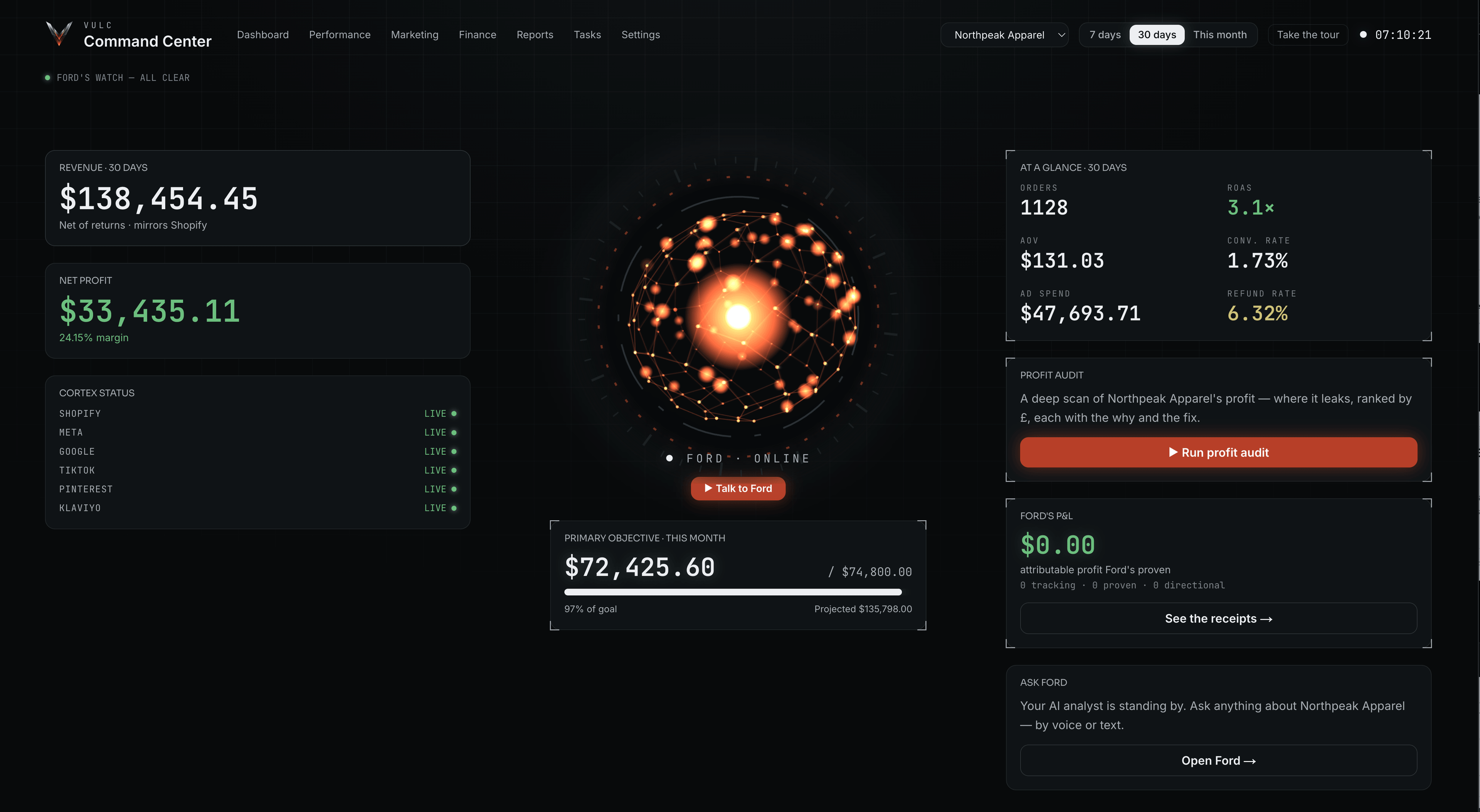
Then I built Ecom Forward, an entire AI commerce platform: an orchestrator directing six specialist agents across a full Shopify, Meta and Klaviyo integration stack, with true per-product profitability underneath. I built it for my own operation first. It is the system Vulc now fits to other businesses, and the demo is open if you want to hold it to that.

That platform has run in production ever since, which is where the years of hands-on work with AI agents come from: designing roles, wiring them to live systems, setting the gates, and finding out what breaks at real volume. Every Vulc build starts from that experience.

My hours were spent in commerce, so that is the operation I know in my hands. The systems are not commerce systems. Agencies, software companies, subscription and service businesses run on the same bones: work arriving faster than people can clear it, and numbers scattered across tools that do not talk. If that is the shape of your business, the category does not matter.

How Vulc thinks about AI

Workflow first.Models second.

The hard questions in an AI build are not about models. They are about the work: what the agent should own, what it needs to know, which systems it may touch, and where a person has to say yes. Get those right and the model becomes an implementation choice rather than the strategy.

Full autonomy demos well and breaks quietly. In a real business, the cost of one wrong refund, one wrong send or one silent failure lands on the owner. So every Vulc system prepares the work and stops at a gate with your name on it: you see the draft and its context before anything moves. That is not a limitation. It is why owners actually turn the system on.

The questions we ask first

  • What should the agent own?
  • What information does it need?
  • Which systems should it use?
  • How should it work, step by step?
  • What should require approval?
  • What does good output look like?

Why ownership matters

Built in your accounts.Owned by you.

I have been on the other side of a vendor's roadmap, paying for a tool that almost fitted and could not be changed. A system you cannot open is a subscription with extra steps. So every build lives in your repository from the first commit, runs on your accounts, and is documented so it keeps running if Vulc's access is removed. Client ownership and approval-first delivery are deliberate principles, not defaults we fell into.

How ownership works in practice

Our own proving ground

We run on itbefore you do.

Vulc uses its own AI operating system internally to run parts of the company, combining AI agents, company knowledge, live tools and human approval where needed.

We use our own systems as a proving ground before applying the same principles to client work.

How we work

Experienced by design.

Directly

Every build is led directly by the founder, from the first call to the handover. You are never handed to a junior consultant or an anonymous delivery team.

From the Netherlands

Based in the Netherlands, building for online businesses anywhere. Working sessions run on video, on your real operation.

In production

Years of building and running AI agents in production, starting with our own operation, before the same principles went into client work.

On your stack

Systems are built in your environment, on your accounts. We hold access while we build, then hand back the keys.

That is the story.Yours is next.